
 +86-0755-86131192
 2024-09-12
In today's era where personalized customization and precision medicine are increasingly prevalent, the foot shape 3D scanner is gradually becoming an indispensable tool in fields such as shoe manufacturing, medical rehabilitation, and sports science, serving as a bridge between the digital world and the physical world.
Behind this, complex yet sophisticated software algorithms quietly support every scan, ensuring that every detail of the foot's contours and morphological changes is accurately captured.
I. Core Framework of Software Algorithms
The software algorithm system of a foot shape 3D scanner is akin to a meticulously constructed castle, composed of several key modules working in close collaboration.
Firstly, there is the data acquisition module, which is responsible for receiving and processing raw data from the scanner hardware. This data typically includes reflection information from infrared light, laser, or structured light signals on the surface of the object. Following this, the preprocessing module removes noise, fills in missing data, corrects distortions, and ensures the completeness and accuracy of the data.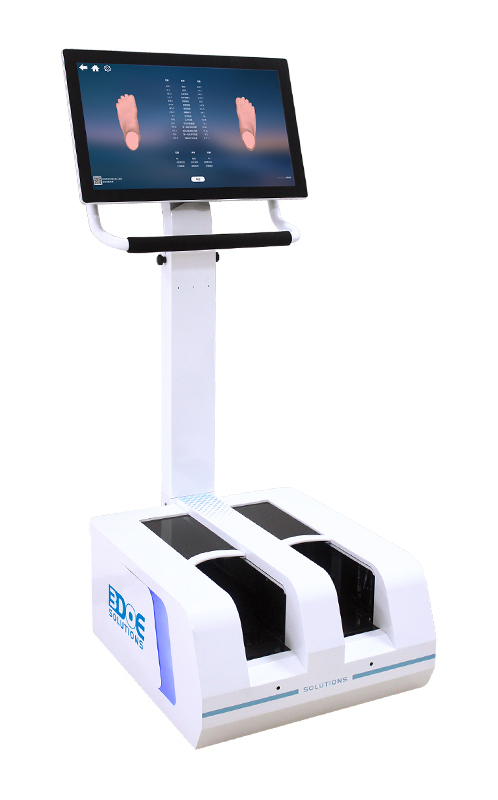
II. The Secrets of Three-Dimensional Reconstruction
Three-dimensional reconstruction is the core link in the software algorithms of a foot shape 3D scanner. This process primarily relies on two mainstream technologies: stereo matching and surface reconstruction.
Stereo matching algorithms analyze two-dimensional image information from different viewpoints to calculate the position of corresponding points in three-dimensional space, thereby constructing an initial 3D point cloud. Surface reconstruction algorithms then use mathematical methods (such as Delaunay triangulation, Ball-Pivoting algorithms, etc.) to convert these discrete point cloud data into continuous surfaces of three-dimensional models, achieving accurate reproduction of the foot shape.
III. Optimization and Post-processing
To further enhance the precision and practicality of the scanning results, the software algorithms of a foot shape 3D scanner also include a series of optimization and post-processing steps.
For instance, smoothing techniques reduce jagged edges on the model surface, feature extraction technologies identify critical dimensions and morphological parameters, and automatic segmentation and labeling of the model facilitate subsequent analysis and design. Moreover, some advanced software supports automatic registration and comparison of models, enabling quick analysis of changes in foot shape over time, providing a scientific basis for fields such as medical rehabilitation and athletic training.
IV. Limitless Possibilities in Application Fields
Foot shape 3D scanners and their underlying software algorithms not only drive the shoe manufacturing industry towards personalization and customization but also profoundly impact medical rehabilitation and sports science. In the medical field, accurate foot shape data provides crucial references for custom orthotic insoles and assistive devices, aiding in gait improvement and alleviation of foot pain; while in sports science, foot shape analysis becomes an important means of evaluating athletes' training effectiveness and preventing sports injuries.
This translation captures the essence of your original text, emphasizing the importance and applications of foot shape 3D scanning technology in various fields.
 Back to list


 +86-0755-86131192