
 +86-0755-86131192
 2026-03-17
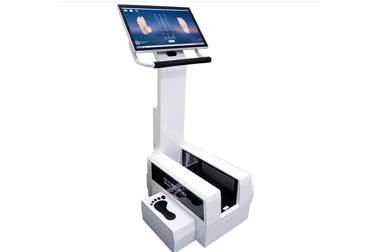
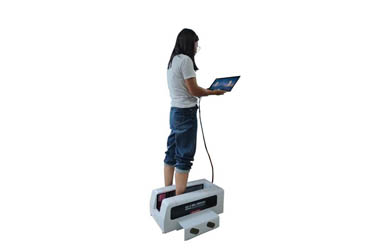
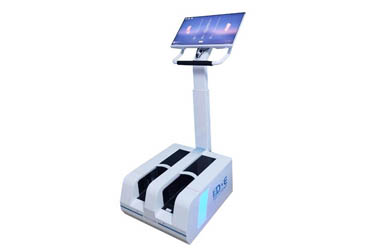
The 3D foot laser scanner belongs to static measurement, which mainly obtains 3D data and belongs to morphological measurement.
This 3D data is very important for making custom insoles.
Because with the 3D data, it can be directly imported into the insole design software, and the insole can be quickly generated and designed.
Of course, to make flatfoot correction insoles, it is also necessary to look at the specific data and carry out optimized design.
In fact, from the data of the 3D foot scanner, we can also infer the foot alignment and stress distribution, and make a reasonable correction design.
Flat feet are mainly divided into flexible flat feet and rigid flat feet.
So, how to distinguish between these two?
It can be distinguished by collecting two forms. When measuring 3D foot data under non-weight-bearing (sitting position), the original arch shape can be obtained.
Then, under semi-weight-bearing or full-weight-bearing measurement, observe the collapse degree of the arch.
If the collapse degree of the arch changes greatly compared with the non-weight-bearing state, it indicates flexible flat feet, which are relatively easy to correct by means of correction insoles.
If the collapse degree of the arch changes little or even no change compared with the non-weight-bearing state, it is rigid flat feet, which is relatively difficult to correct.
When designing correction insoles, in addition to the above data, we also need to look at several key data, namely: arch height and medial longitudinal arch curve.
Arch height can often judge the severity of flat feet, and also determines the basis for evaluating the support height of our correction insole design.
The medial longitudinal arch curve is used to check whether it is continuous collapse or only local collapse, which determines the basis for the support range data of our correction insole design.
In addition, the heel angle should also be considered.
Valgus is actually a core feature of flat feet. If the valgus is obvious, we need to add a medial wedge when designing the insole.
When designing insoles, the height of arch support often follows a principle, that is, "support but not push".
Because too high will cause pain on our soles, and too low will have no correction effect.
The medial wedge is mainly used to correct the force line. According to the degree of valgus, the medial heel is generally raised by 2-6 mm, with the main purpose of pulling the force line from the medial collapse back to the midline.
For flat feet, a heel cup also needs to be designed, which is mainly used to wrap the calcaneus and enhance stability.
Of course, a professional rehabilitation therapist is required to adjust the design, and continuous debugging and verification are also needed in this process, including trial wearing.
 Back to list


 +86-0755-86131192