
 +86-0755-86131192
 2025-11-20
Flat feet, foot eversion, inaccurate shoe size, insoles not fitting the foot shape, and large errors in traditional foot molds… Foot measurement methods have long been limited to two-dimensional prints and manual experience, making it difficult to fully display the detailed structure of the foot.
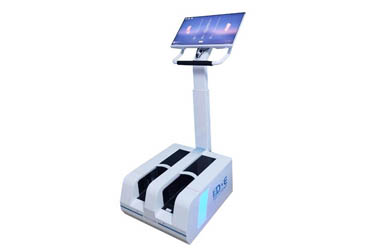
With the arrival of the era of digital and intelligent measurement, three-dimensional foot shape scanners have gradually become an important method in foot detection and footwear customization.
Laser three-dimensional foot scanning can not only accurately capture the external shape of the foot but also output millimeter-level data, so as to scientifically design lasts, uppers, insoles, and orthotic solutions. So, what is the laser imaging principle of a 3D foot shape scanner? And in what aspects can it be applied?
I. Basic principles of laser scanning imaging
1. Structured light reflective imaging, etc.
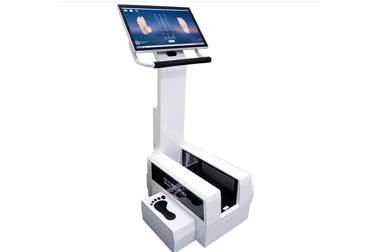
Laser three-dimensional foot scanners generally use structured light projection technology.
The device projects regular light stripes onto the foot surface and uses a camera module to capture the deformation of the stripes. According to the changes in the light stripes, parameters such as height, concavity and convexity, and volume of points on the foot surface can be calculated backward, forming a complete three-dimensional model.
Compared with traditional photography, structured light does not rely on manual recognition. It can automatically record fine details such as instep height, toe position, and foot arch curvature, reducing experience-dependent human error.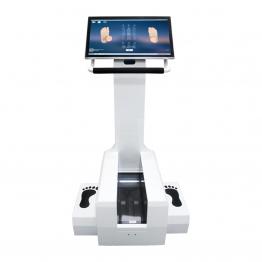
2. Triangulation positioning, etc.
The laser emitter, camera, and measured surface form a stable triangular structure. The system calculates the relationship between the offset angle of the light spot and the distance, thus obtaining spatial coordinate point clouds of the foot and performing millimeter-level precision imaging.
This method images quickly, with stable calculation, and is especially suitable for scanning human body surfaces, while also avoiding the need for the measured object to maintain posture for a long time.
3. Real-time establishment of 3D data models
The scanner carries 3D reconstruction algorithms to process the massive point clouds obtained:
Automatic stitching
Surface fitting
Noise filtering
Data smoothing
Finally, a high-definition 3D foot model is formed, which can be used for last design, size judgment, insole production, and orthotic analysis.
II. Professional data output
1. Obtaining key foot shape indicators
Compared with traditional footprints and measurement tools, laser 3D scanning can output dozens of quantifiable indicators in one scan, such as:
Arch height
Instep height
Toe angle
Foot thickness
Forefoot width
Heel circumference
These parameters help professionals objectively evaluate foot structure and avoid “choosing shoes based only on feeling.”
2. Visualization of foot pressure (in some systems)
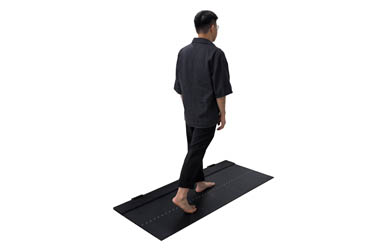
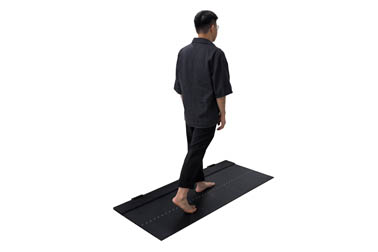
Some scanning systems can be used together with pressure sensing plates to complete:
Dynamic gait analysis
Center of gravity trajectory
High-pressure heat maps
Differences in load between left and right feet
This helps detect high arches, calluses, metatarsalgia, and midfoot collapse.
III. Enabling personalized customization
1. Shoes made according to individual characteristics
Different people have significant differences in foot shape, and even with the same length:
Different forefoot width
Different instep height
Different proportions between forefoot and rearfoot
Different angles of heel valgus
Traditional shoe sizes cannot satisfy such refined differences. A 3D scanner can directly import personal data into industrial CAD software to achieve:
Digital last matching
Optimization of inner space adaptation
Precise structural division of shoe uppers
Allowing footwear to truly achieve a “one-foot-one-fit” effect.
2. Precise modeling of orthotic insoles
Combined with 3D design software, the scanner can create insole models based on laser data, and then produce personalized orthotic insoles through CNC machining or 3D printing.
Suitable for:
Flat feet
High arches
Metatarsalgia
Plantar fasciitis
Abnormal knee/ankle force lines
Compared with traditional manual foot molds, it is more scientific, stable, and reproducible.
IV. Advanced manufacturing and medical application
1. Footwear design and development
Laser foot scanners have become an important data source for footwear companies when selecting lasts and designing shapes.
Engineers can analyze target population foot shape trends using foot shape databases, such as:
Regional differences (e.g., foot girth difference between north and south)
Age differences (e.g., elderly people have wider insteps)
Gender differences (e.g., men’s feet are flatter in profile)
These trends allow formulation of shoe shape standards.
2. Medical rehabilitation (orthopedic medicine)
In hospitals and rehabilitation centers, 3D foot scanning can be used for:
Evaluation of force line correction
Structural design of orthotic braces
Tracking improvement in gait function
Achieving a shift from “experience judgment” to “data-based diagnosis.”
3. Sports protection and performance footwear
Laser data can analyze the structural forces on the foot during exercise:
Building shock-absorbing zones
Strengthening power transfer structures
Reducing sports injuries
Providing more professional protection for sports such as soccer, running, basketball, skiing, etc.
V. Consumer experience and service upgrade
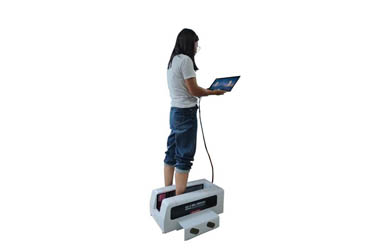
Laser 3D scanners feature fast measurement, non-contact operation, and no radiation. Consumers can obtain all data in just a few seconds.
They are very suitable for:
Brand online and offline stores
Intelligent foot measurement experience areas
Flagship stores providing customized footwear
Improving the efficiency and accuracy of the “measure → choose size → try → order” service process.
 Back to list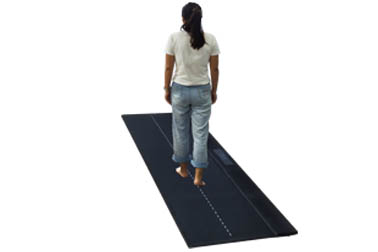


 +86-0755-86131192