
 +86-0755-86131192
 2025-11-19
Differences in foot shape, insufficient support points, landing deviation, imbalance of the center of gravity, local high pressure on the forefoot… all may cause instability or even injury to lower limb movement.
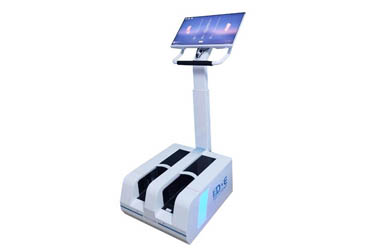
Just as lenses can make vision clear at a glance, the plantar pressure distribution system can also serve as a “foot diagnostic instrument,” truly restoring pressure tracks and dynamic force patterns, thereby helping insole design change from experience to accuracy and from tradition to science.
An insole is not simply a pad; it is a “micro-mechanical structure,” bearing the human body.
A truly effective insole is not about “looking comfortable,” but about being scientifically designed based on data. With the plantar pressure distribution system, insoles can be optimized in force distribution and foot protection according to individual foot shape, gait, and movement environment.
So how is the pressure distribution system applied in insole design? A scientific insole should have the following features:
I. Based on precise biomechanical analysis
1. Identifying plantar force characteristics
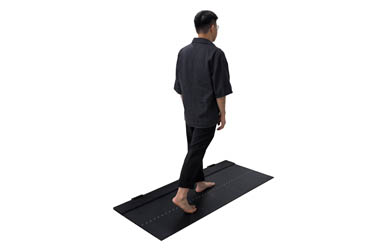
The plantar pressure system can collect in real time information such as landing sequence, pressure peaks, force area, and center-of-pressure trajectory during standing, walking, and even running and jumping.
For conditions such as high pressure in the forefoot, excessive heel impact, or excessive medial or lateral load, the insole design can adjust force distribution through local buffering, support, or structural adjustment, allowing foot forces to “apply force when needed and disperse when needed.”
2. Correcting movement force lines
Pressure data can also reflect changes in lower limb force axes, such as inversion, eversion, stride deviation, and heel pressure trends.
In insole design, supporting structures, support height, and changes in force areas can be used to guide the lower limbs back to a stable movement trajectory, thereby reducing long-term wear on the knee, ankle, and hip joints.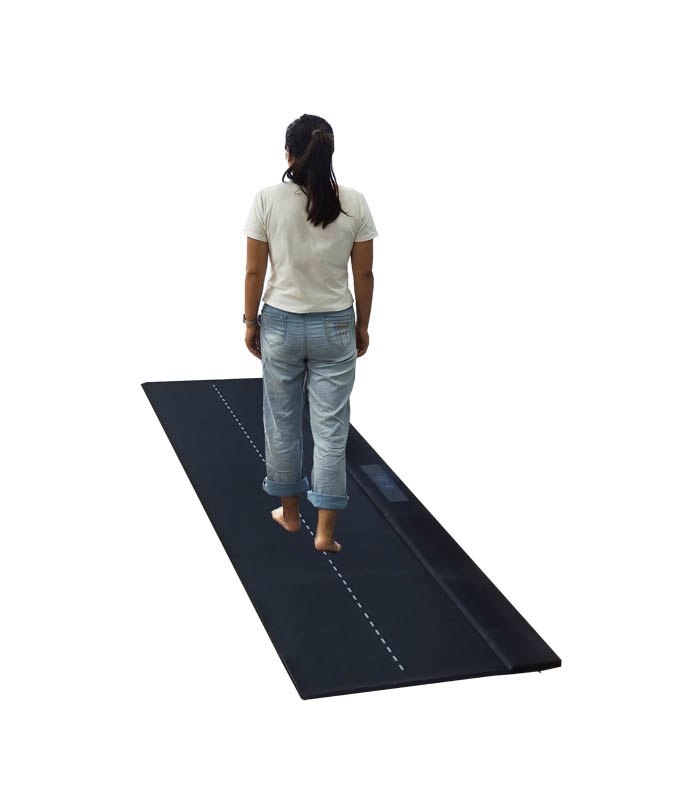
II. A personalized design approach
1. Determined by data rather than experience
Everyone has different foot shapes, weight, walking patterns, and activity frequency. A scientific insole should not be a “unified template.”
Through the data collected by the pressure distribution system, designers can discover details that the naked eye cannot capture—such as overload of the first metatarsal, excessive rearfoot deviation angle, or insufficient pressure on the little toe—and design contours accordingly, rather than “relying on feel.”
2. Dynamic adjustment over time
For athletes, children, or those recovering from injuries, their foot conditions will change, such as:
Increased training causing changes in metatarsal pressure
As muscle strength improves, the center of gravity becomes more balanced
Growth and development affect arch height
Therefore, insole design requires not only “one-time design,” but also “periodic review and fine-tuning,” just like regular vision calibration, to ensure continuous effectiveness of correction.
III. Scientific use of materials and structure
1. Material selection is not simply “the softer the better”
The pressure distribution system shows stress magnitude and repetitive impact at different foot points, so insole materials must correspond:
Core force areas: elastic support materials (such as TPU structures)
High-pressure concentration areas: energy-absorbing or cushioning materials (such as EVA)
Long-friction areas: supporting and wear-resistant layers
Different foot regions use materials based on “data needs,” rather than using a uniform density everywhere.
2. Finer structural zoning
Through heat-map analysis, insoles can be processed by zones:
Primary overload areas: local height increase or decrease to offload pressure
Insufficient support areas: added stabilizing structure to strengthen arch rebound
Heel impact zones: multi-layer cushioning structures to absorb shock
Thus, insoles evolve from “overall support” to “zoned adjustment.”
IV. Improved wearing comfort experience
1. Fits the contour but does not create pressure
The plantar pressure system observes not only “force magnitude,” but also “dynamic foot shape changes.”
Therefore, the insole contour should not be rigid but should:
Fit the arch when static
Allow slight deformation when moving
Providing support and constraint while walking.
2. Does not change the walking style, only improves it
The goal of a scientific insole is not to “make people adapt to the insole,” but to:
Guide the insole to gradually correct force lines along the natural gait, making plantar pressure distribution more reasonable.
Users will not feel strange or uncomfortable when wearing it. Instead, during daily movement and training, force is subtly redistributed, and the risk of injury gradually decreases.
Only visible data leads to correct structure; only when foot force distribution is clearly understood can an insole fulfill its true role.
The plantar pressure distribution system enables insole design to shift from “experience-based” to “science-verified,” making support, pressure relief, protection, and correction more “quantifiable, traceable, and continuously optimized” in actual effect.
 Back to list


 +86-0755-86131192