
 +86-0755-86131192
 2025-11-19
Flat feet, high arches, forefoot valgus, heel inward rotation, arch collapse... many of these foot problems in most cases cannot be accurately judged by the naked eye.
Just as vision examination requires professional optometry equipment, the evaluation of foot structure must also rely on precision instruments. The 3D foot scanner and the traditional foot mirror are two completely different detection approaches.
The foot mirror allows the foot sole contour to be visually observed, while the 3D laser scanner can achieve millimeter-level three-dimensional measurement, thus promoting foot assessment from “visual inspection” into an era of “quantitative recording and precise analysis.”
So, how is the laser imaging principle applied in the 3D foot shape scanner? Compared with the traditional foot mirror, what are its advantages?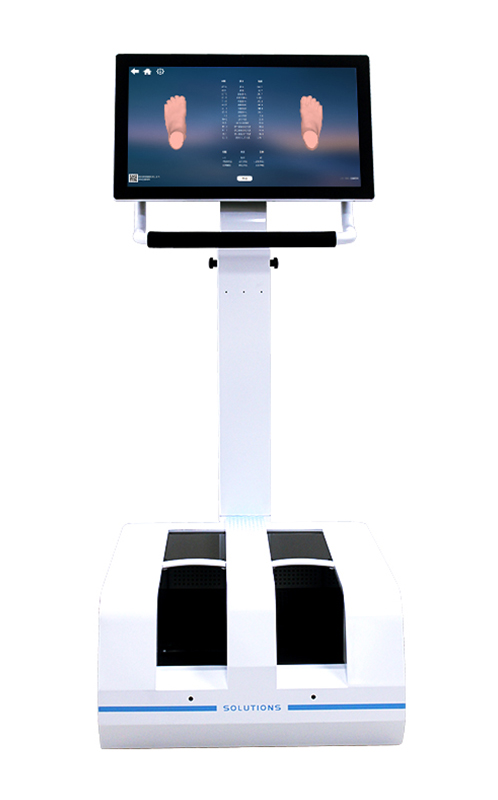
I. The imaging principles are different
1. 3D laser scanning
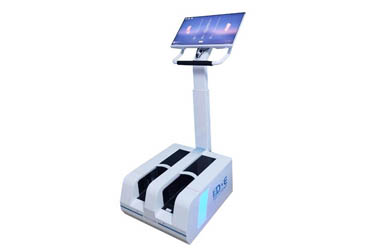
The 3D foot scanner projects high-speed laser lines or laser dot matrices onto the foot surface. When the light encounters uneven structures, positional deviations appear. The camera system captures these deviations in real time, thereby generating three-dimensional point-cloud data.
By combining a large number of point-clouds, a complete three-dimensional model from instep to sole can be reconstructed and used to accurately measure:
Foot length, foot width, arch height
Curvature of the instep
Hallux valgus angle
Dorsal height
and other multi-dimensional three-dimensional parameters.
This imaging does not rely on manual experience but is realized through optical geometric calculation, so the true foot morphology can be completely and objectively restored.
2. Foot mirror relies on optical reflection imaging
The foot mirror displays the contact area between the foot sole and shoe sole through transparent reflective surfaces.
Users mainly observe:
Sole pressure marks
Large contact area
Pressure distribution contour lines
But it is difficult to record the full shape of the instep, arch height, and toe deviation angle. It is a detection method based on visual observation.
II. The dimension of information presented is different
1. 3D scanning enables full three-dimensional measurement
The laser scanner collects not “appearance shape” information, but:
Digital
Measurable
Calculable
three-dimensional data.
The test results can output images and also derive:
Multi-dimensional volume models
Data sample comparisons
Foot surface curvature analysis
They can even be imported into CAD systems for insole, shoe last, or customized footwear design, bringing foot evaluation directly into the digital design process.
2. Foot mirror is “only observable and not easy to measure”
Foot mirror results depend on visual judgment and can only obtain:
Which area has larger contact
Which area has deeper coloring
Whether the center of gravity has shifted
Although intuitive, it is difficult to quantify, reproduce, or carry out in-depth structural analysis.
III. The applicable scenarios differ
1. 3D scanning is suitable for customized applications
Because it outputs a complete 3D model, it is widely used in:
Orthotic insole design
Custom shoe last manufacturing
Foot function assessment
Long-term lesion tracking
Medical rehabilitation monitoring
Especially in children’s skeletal development or long-term tracking of athletes’ foot changes, it enables comparison, archiving, and review.
2. Foot mirror is suitable for rapid initial screening
Foot mirror detection is often used for:
First-time in-store preliminary evaluation
Quickly determining pressure extent on the sole
Helping customers perceive foot problems
Because it is simple, requires no special training, and has low operating cost, it still has market value, but is not suitable for high-precision intervention.
IV. The controllability and error range of the results are different
1. 3D scanning data is more stable
Laser measurement does not rely on experience, and mostly features:
Automatic calibration
Digital modeling calculation
Millimeter-level error control
Repeated scans in the same environment can achieve extremely consistent models.
2. Foot mirror is easily affected by human factors
Including:
Incorrect standing posture
Changing light angles
Different observer viewing angles
Different subjective experience interpretations
The same foot may produce completely different results when tested by different operators.
V. Combining the two produces better results
Foot mirrors emphasize “visual presentation,” while 3D scanners emphasize “quantitative data.”
Therefore, in professional foot services, a process often emerges:
First use a foot mirror to visually show results
Then use 3D scanning to achieve precise modeling
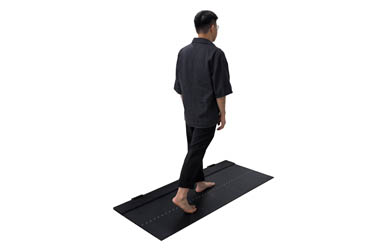
Finally combine gait and pressure testing
Thus forming a complete closed loop from “sensory perception” to “objective analysis.”
 Back to list


 +86-0755-86131192