
 +86-0755-86131192
 2026-06-11
The main morphological feature of flat feet is a significant reduction in the vertical height of the medial longitudinal arch, an insufficient depression degree of the dorsal three-dimensional contour, and a three-dimensional range of the midfoot area contacting the ground that is far greater than that of normal feet.
Especially the vertical drop of the medial arch of the sole is relatively small, the angle of hindfoot varus and the relative offset degree of the first metatarsal are abnormally prominent, in addition, the three-dimensional alignment deviation between the anterior and posterior segments of the foot is also relatively obvious, especially the lack of three-dimensional curvature of the medial arch.
In severe cases of flat feet, the three-dimensional surface of the medial longitudinal arch of the sole completely disappears, and the overall sole nearly forms a flat plane structure.
Generally, the evaluation of flat feet is mainly calculated based on the Arch Height Index (AHI), Arch Height Index (AHI) = the vertical height of the lowest point of the arch ÷ the straight-line distance from the center of the heel to the end point of the first metatarsal.
The smaller the AHI value, the lower the vertical height of the arch, and the heavier the degree of flat foot deformity.
Of course, the three-dimensional stereoscopic data collected by scanning is compared with the standard healthy foot database, and there are scientific, objective, and industry-universal three-dimensional foot parameter reference standards.
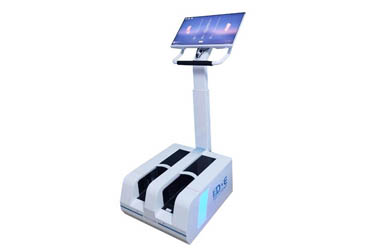
And the 3D foot laser scanner is a detection device for collecting the three-dimensional contour of the foot, mainly utilizing core principles such as laser triangulation ranging, structured light scanning, and optical imaging capture to sense the complete plantar surface, lateral contour of the foot, and three-dimensional stereoscopic height data of the arch under static standing conditions.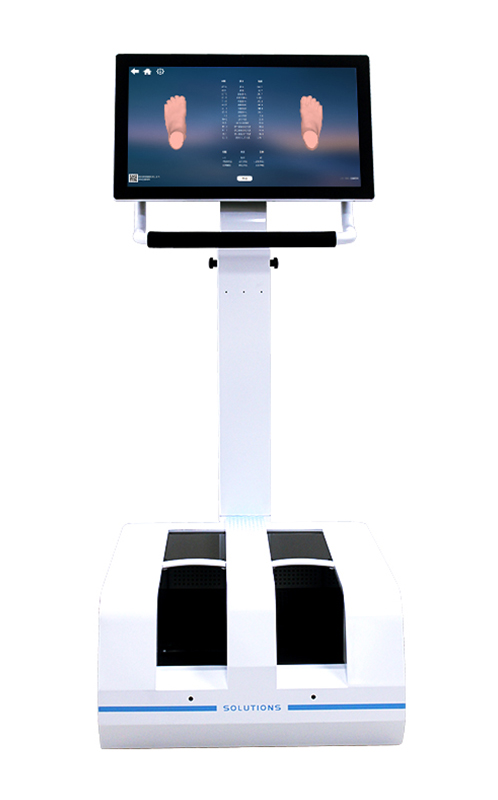
The precision of the 3D foot laser scanner is mainly the three-dimensional spatial error of a single point, the higher the precision, the more able to subtly capture subtle arch collapse, subtle bone displacement of the foot, and other foot morphological abnormalities that cannot be recognized by the naked eye.
After completing the full-domain scanning of the foot, the 3D foot laser scanner will model and visualize the collected three-dimensional raw data in the supporting computer software, generating a three-dimensional point cloud map and cross-sectional views of the foot, for example, warm-colored areas indicate the low-lying collapsed areas of the arch, natural skin-colored areas represent the normal foot surface areas, and cold-colored areas represent the high-suspended areas of the arch.
Through the three-dimensional color point cloud map and cross-sectional lines in the scanning report, we can also intuitively view the overall three-dimensional morphology of the foot, and accurately determine the location and magnitude of the arch collapse.
In addition, the measurement report also relies on the Arch Height Index (AHI) to quantitatively divide flat feet into mild, moderate, and severe grades.
It is also possible to judge the degree of hindfoot varus/valgus, forefoot abduction, and the linked deformity degree of flat feet through the analysis of the foot central axis and the plantar cross-sectional contour curve.
Of course, there are also multiple styles of 3D foot laser scanners on the current market, and different styles can be adapted to different detection and production scenarios.
The main differences are the size of the scanning cavity space, the single-scan field of view, the density of laser point arrangement, and the number of global optical acquisition lenses.
The higher the density of laser points, the higher the precision of three-dimensional modeling, the smaller the measurement error of the three-dimensional dimensions of the foot, the more able to objectively restore the true morphological shape of the bones and soft tissues of the foot, and accurately judge the structural health problems of the foot.
3D foot laser scanners are commonly applied in orthopedic foot disease screening, adolescent foot development monitoring, three-dimensional modeling of personalized orthotic insoles, digital patterning of medical orthopedic shoes, and preoperative evaluation and postoperative rehabilitation comparison of foot deformities.
 Back to list


 +86-0755-86131192