
 +86-0755-86131192
 2026-07-22
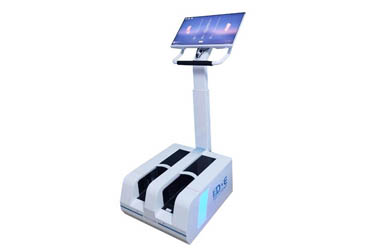
The foot laser scanner, its core working principle is to measure data such as the three-dimensional geometric morphology and contour dimensions of the foot under the state of static standing.
Inside the foot laser scanner, a laser emission source, a high-precision industrial camera, and a precision mechanical transmission device are built-in, and this technology belongs to non-contact optical measurement.
When there is no scanning task, these core optical components are in a standby state, the system performs self-check and calibration internally, and almost no data calculation is performed.
When a person stands on the scanning platform, the laser projector casts a slender laser line covering the foot surface, and since the foot has undulations such as the arch and the instep, the laser line will undergo bending deformation accordingly; the more comprehensive the coverage (referring to light coverage here), the more complete the collected contour becomes.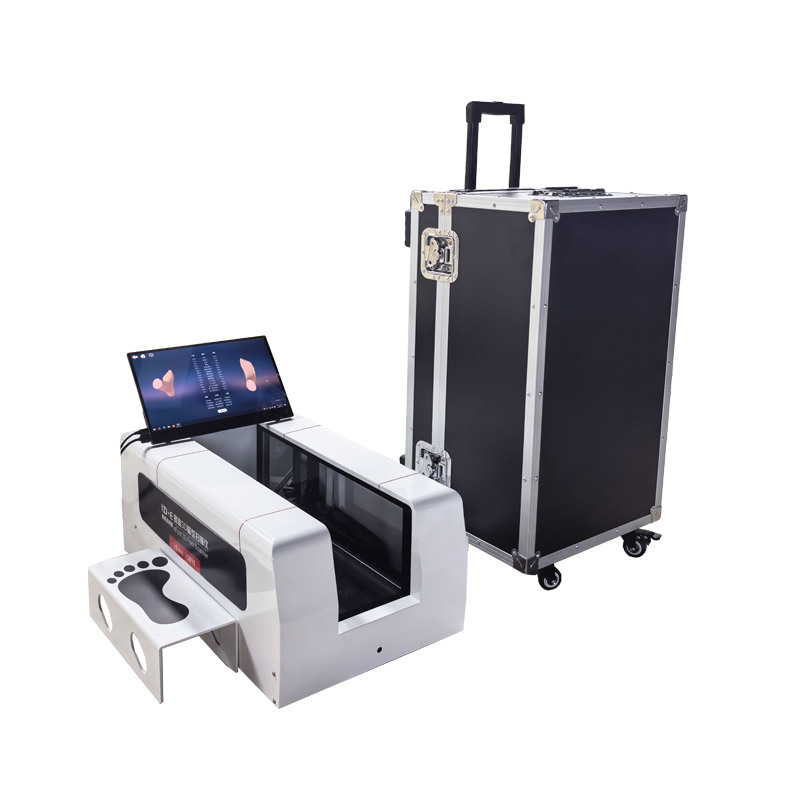
The image acquisition module captures the image of the laser line of every cross-section in real-time, and through the triangulation calculation mechanism, converts the pixel coordinates into specific spatial three-dimensional coordinates (X, Y, Z), and displays them on the software in forms such as a foot 3D model.
Of course, in addition to collecting and sensing through the laser triangulation method, some high-end equipment also uses structured light technology for collection and sensing.
The data measured by the foot laser scanner generally includes various dimensions of the foot (foot length, foot width, instep height, foot circumference), arch type (high arch, normal, flat), forefoot-to-hindfoot ratio, left-right foot symmetry analysis, key anatomical point positions, foot volume, surface area, and other data.
After the measurement is completed, it is generally displayed through a visual 3D model report, and there are also 3D model files in formats such as STL and OBJ.
The most common major applications of the foot laser scanner are:
1. Applied in the customization and production of personalized footwear.
For example, obtaining precise foot shape data for 3D printing shoe lasts and customizing exclusive sports shoes and leather shoes to solve the problem of shoes squeezing or grinding feet.
2. Conducting the design and production of orthotic insoles and assistive devices.
Before the design, measuring data such as the foot's three-dimensional morphology provides reliable data for the arch support and heel cup design of the insole, making the orthotic scheme more fitting and comfortable.
After the production, by comparing the scanning data with the finished model, one can judge and evaluate the matching situation of the assistive device or guide the subsequent shaping and polishing.
3. Applied in foot health screening and biomechanics research.
Through the data, providing researchers or doctors with the ability to analyze foot development conditions or monitor the risk of foot ulcers in diabetic foot patients, promoting scientific research.
4. Applied in intelligent size selection and inventory optimization for footwear brands.
By measuring the precise foot shape data of consumers, the most suitable shoe size and last model can be recommended, and based on the big data of foot shapes of the regional population, the brand's stocking strategy can be optimized to achieve the goal of reducing the return rate.
5. Applied in prosthesis manufacturing and mirror restoration.
In medical rehabilitation centers, prosthesis factories, etc., for example, when a patient is missing a foot, the three-dimensional model of the affected side can be copied through the mirroring principle based on the scanning data of the healthy foot, designing a prosthesis with an appearance completely consistent with the healthy side, helping the patient recover normal walking appearance and function.
 Back to list


 +86-0755-86131192