
 +86-0755-86131192
 2026-11-02
Many business owners in the foot care and corrective insole industry have used 3D foot scanners.
However, many of them have discovered a common problem. When purchasing the equipment, the measurement reports show that all the data looks good and the parameters look impressive. But when they actually use these measurement data to design and manufacture corrective insoles and customized insoles, customers report that the corrective results are poor. Some even experience discomfort, pressure points, or a particularly uncomfortable feeling after putting on the insoles. This leads to a series of after-sales problems.
Some professionals, after using certain 3D foot scanners, have also found that identifying flat feet and high arches is often not as accurate as expected, and in some cases, even leads to incorrect assessments.
Why does this happen?
In fact, the most important root cause of this problem is the foot arch.
It is important to understand that most 3D foot scanners currently available on the market use infrared structured light or camera-based image acquisition technology to scan the feet.
However, our foot arches are naturally blind spots. It is very difficult for light to reach these areas. Therefore, the arch data is not actually captured through real scanning, but instead is filled in through software interpolation.
There is a fundamental difference between real measurements and data generated through software interpolation. The error in arch height between actual measured data and software-interpolated data is often greater than 3 mm.
Because the actual arch height data cannot be seen, when identifying flat feet and high arches, these scanners can only rely on the footprint area for calculation and assessment. This assessment method is essentially the 2D footprint method.
However, this assessment method can easily lead to misjudgments. For example, children's feet may be plump and have more soft tissue. When the feet spread out under pressure, the system can easily identify them as flat feet. Generally, only flexible flat feet collapse when weight is applied. If we only look at the footprint, it is difficult to distinguish between these conditions.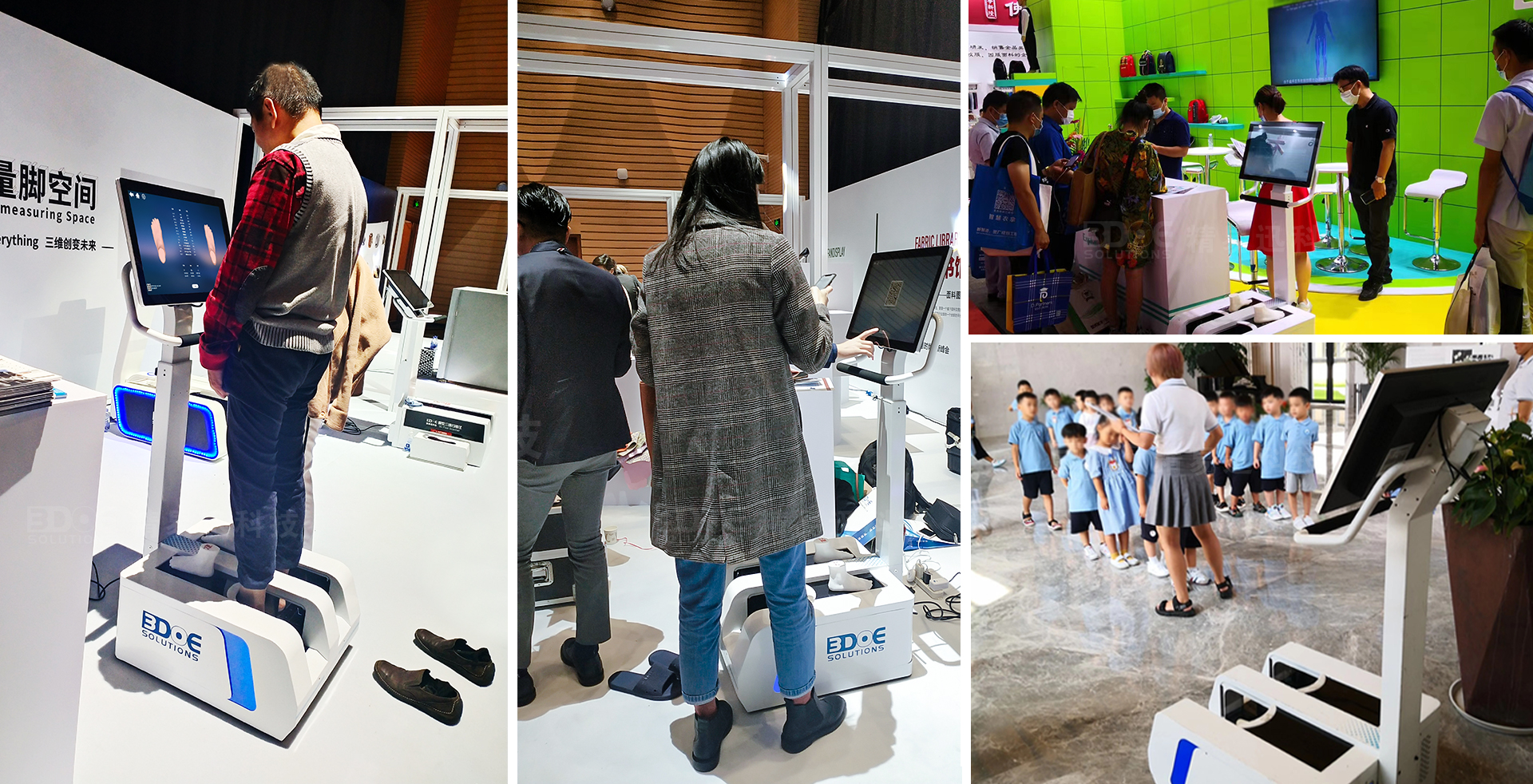
For people with less plantar fat, their footprints may be smaller. Directly identifying them as having high arches is also inaccurate, because the actual plantar arch height and high-pressure points cannot be seen at all.
If the assessment of flat feet and high arches is inaccurate, the measurement results will be distorted and will have very little practical value.
Furthermore, if these data are used to design corrective insoles, the errors will accumulate even further.
Generally, the lift or support height of corrective insoles is only around 4–12 mm. An error of more than 3 mm accounts for a very significant proportion of this height. If we also consider factors such as EVA material compression under pressure, the errors will accumulate even further.
As a result, the insoles produced may not only fail to achieve the intended corrective effect, but may also cause pressure points and foot discomfort. Customer satisfaction will be low, leading to various returns and exchanges. Brand reputation will decline, and repeat purchase rates will also struggle to reach satisfactory levels.
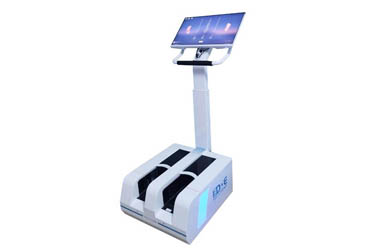
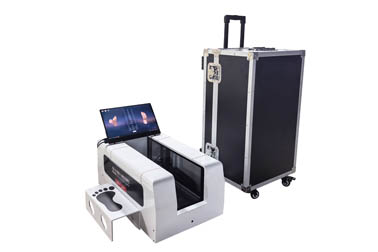
The 3DOE 3D foot scanner uses a dual-foot, 16-viewpoint surrounding line laser scanning system. Multiple laser beams can directly illuminate the inner side of the arch, beneath the navicular bone, and the curved surfaces of the foot arch.
The collected data is real measurement data, not data generated through software interpolation. Its measurement accuracy reaches within 0.5 mm, allowing the actual foot arch height to be clearly captured.
Because it can capture real plantar arch data and 3D foot data, the assessment of flat feet and high arches no longer relies solely on footprint area. Instead, it combines arch height, vertical navicular drop, medial longitudinal arch angle, and arch length (arch span) for a multi-dimensional joint assessment.
The assessment results are more objective and accurate, with smaller measurement errors. It can accurately classify mild flat feet, moderate flat feet, severe flat feet, mild high arches, moderate high arches, and severe high arches.
Only when the measured 3D data is applied to the corrective and customized design of insoles can it provide genuine corrective value.
After customers put on the insoles, their feet can also be measured again for data comparison. This makes it possible to observe actual changes in the foot arch and quantify the corrective results.
With accurate and reliable data, the corrective insoles produced can deliver results. Customers enjoy a better wearing experience, repeat purchase rates increase, and it becomes easier to achieve higher-value sales.
Customers may not necessarily understand the technical accuracy figures, but they can see the before-and-after comparisons. They are willing to pay for professional solutions that deliver measurable results and consistent performance.
 Back to list


 +86-0755-86131192