
 +86-0755-86131192
 2026-11-05
What Are the Differences and Impacts on Insole Design Between Foot 3D Laser Scanners with 1mm Accuracy and 0.5mm Accuracy?
An improvement in accuracy does not mean that the corrective effect of insoles will improve by the same factor. The core value of improved accuracy lies in whether more accurate and real foot shape data can be obtained and applied to the design of custom insoles.
Suppose that foot 3D scanning devices with 1mm accuracy and 0.5mm accuracy are used to measure the arch height of the same person.
For example, if this person's actual arch height is 20mm, the measurement result from a foot 3D scanner with 1mm accuracy may be 19-21mm, while the measurement result from a foot 3D laser scanner with 0.5mm accuracy may be 19.5-20.5mm.
This means that under the same measurement conditions, the device with 0.5mm accuracy produces measurement results that are closer to the actual dimensions.
In custom insole design, arch height data is one of the most important design reference measurements.
The data measured by a device with 1mm accuracy may have greater deviations, which can affect the initial design of the arch support height, while the data measured by a device with 0.5mm accuracy can provide more detailed arch measurements for insole design, allowing designers to create custom insoles that fit the soles of the feet more closely and provide better corrective support.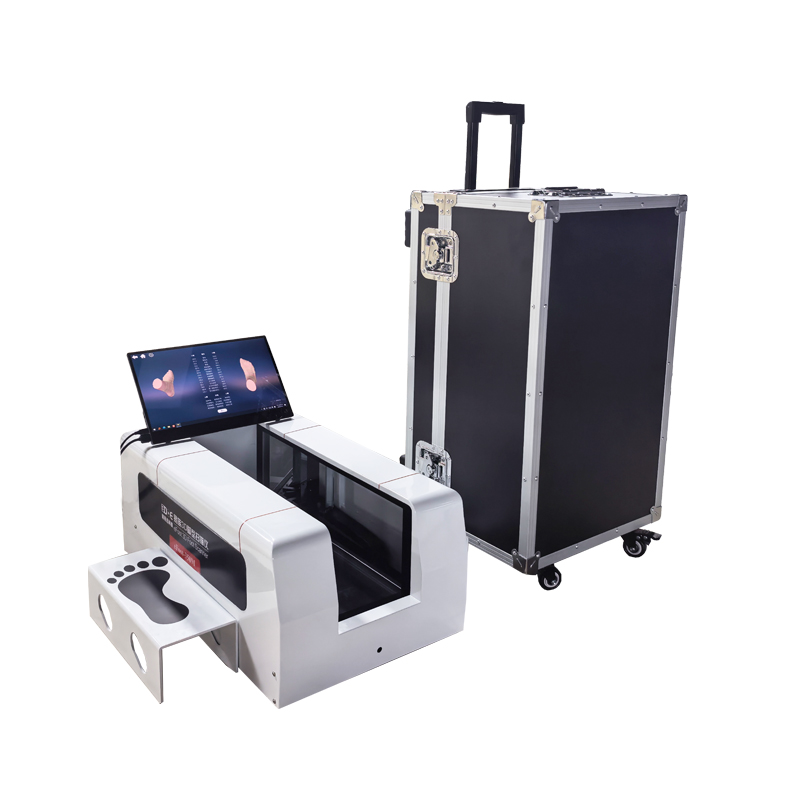
Of course, when designing insoles, it is necessary to consider not only arch height, but also adjustments to multiple areas, including the forefoot, heel, and plantar curves. The higher the accuracy of the device, the more accurate the plantar contour data obtained, which can reduce local fitting problems caused by dimensional deviations.
In addition, the left and right feet of most people are not completely symmetrical, and the dimensional data of the two feet can even differ significantly.
When we use a device with higher accuracy for measurement, we can obtain more detailed and accurate data about the actual shape of both feet, providing designers with more precise and detailed dimensional references. Designers can then create targeted designs for the left and right feet separately, rather than simply using the same parameters for both feet.
Especially when designing custom corrective insoles for people with mild flat feet or mild high arches, higher accuracy makes fine adjustments easier, which can help improve the effectiveness of corrective insoles.
Of course, to achieve relatively ideal results, in addition to measurement accuracy and data authenticity, subsequent software processing and model correction will also affect the final product.
A high-accuracy device can not only reduce measurement errors in key foot dimensions, but also help avoid blind spots in critical areas or excessive reliance on software-based calculations and estimations. This provides a more accurate data foundation for personalized insole design, adequate support, plantar fitting, and corrective design.
 Back to list


 +86-0755-86131192