
 +86-0755-86131192
 2026-09-07
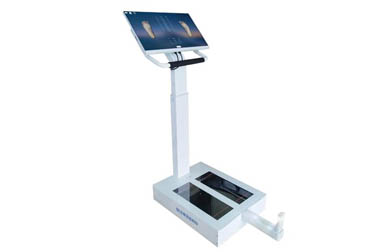
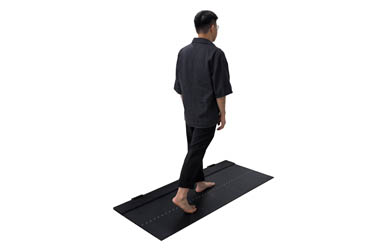
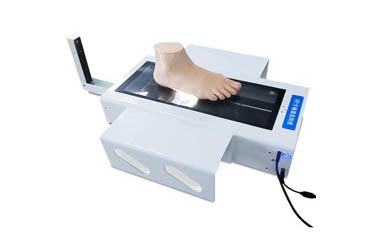
A 3D foot scanner is a professional device that relies on optical sensors, cameras, or other 3D scanning technologies to collect three-dimensional foot-shape data such as foot length, width, height, arch shape, and instep contour when a person is standing, and converts the foot’s spatial shape that is invisible to the naked eye or difficult to measure accurately into visualized 3D models, dimensional data, and quantitative reports.
The core principle of 3D foot scanning can be simply understood as: the human foot enters the scanning area → the 3D scanning device collects data → image/spatial data acquisition → software calculation → foot-shape data and 3D images are generated.
When a person’s foot enters the sensing area of the 3D foot scanner, the scanning device detects the spatial contours at different positions of the foot in real time and collects the corresponding three-dimensional data.
The higher the accuracy of the scanning device, the more detailed the spatial-shape data of the foot that can be obtained.
The three-dimensional foot information collected by the scanning device is read through the data acquisition module and transmitted to terminals such as computers/tablets, and is presented in the software in the form of visualized and chart-based information.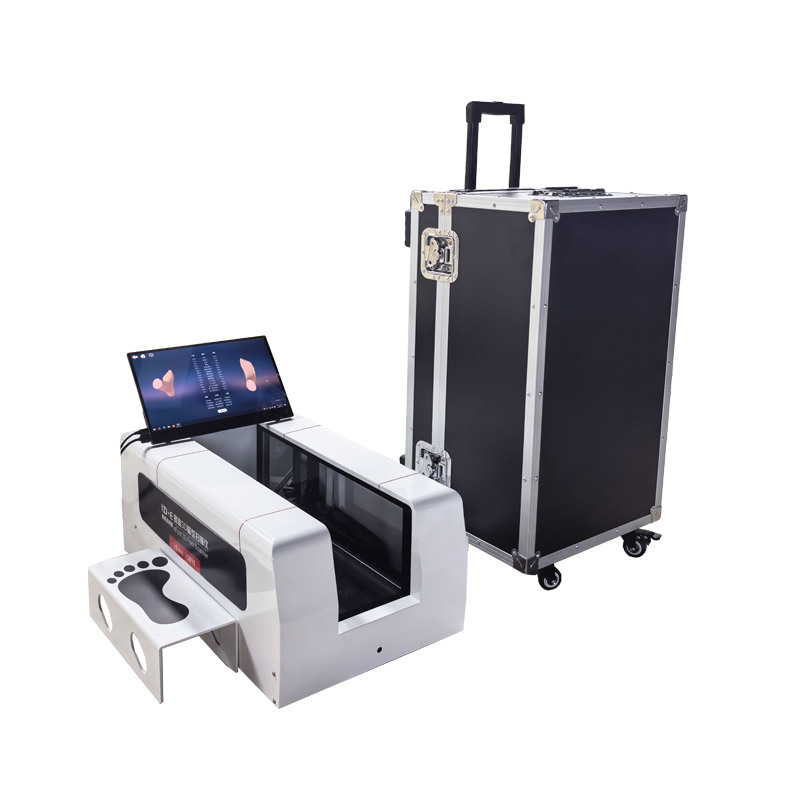
The most common application areas of 3D foot scanners are as follows:
1. For foot-shape assessment.
Through the measured foot-shape data and 3D models, we can assess whether our foot dimensions are balanced, whether there are significant differences between the left and right feet, whether there are differences in the width and height of different areas of the foot, and what the overall spatial shape of the foot is, etc.
2. For foot-shape analysis.
Through a 3D foot scanning system, we can collect the three-dimensional spatial shape of the foot when a person is standing.
For example, detecting foot length → foot width → forefoot width → arch height → instep height throughout the process of changes in foot-shape data.
These data can be applied to foot-shape research, footwear design, and personalized product development.
3. For footwear development.
By testing and comparing foot-shape data such as foot length, foot width, instep height, and arch shape among different groups of people, we can further optimize shoe-last design, shoe structure, sizing systems, internal shoe space, and the fit performance of footwear.
4. Applied in ergonomics.
3D foot scanning can help footwear designers and ergonomics researchers analyze: differences in foot shapes among different groups of people, changes in left and right foot dimensions, changes in forefoot width, arch height, and instep space.
These data can better optimize footwear product design and improve the fit of footwear to different foot shapes.
5. Applied in personalized customization.
For example, testing can be carried out at different stages of customization: initial scanning → foot-shape analysis → product design → customized production → final fitting.
Through the three-dimensional foot-shape data from different stages, we can determine the fit between the product and the foot shape and make corresponding product design optimizations.
When purchasing a 3D foot scanner, it is recommended to select one based on the following aspects.
First is scanning accuracy and resolution.
Because the higher the scanning accuracy, the more detailed the three-dimensional shape data of the foot that can be obtained.
Of course, higher scanning accuracy is not necessarily always better, but rather, our usage scenario needs to be considered; for example, if the space is very small, a 3D scanning device with a large size and an excessively large scanning range would not be suitable.
In addition to paying attention to scanning accuracy and resolution, it is also necessary to pay attention to the scanning speed of the device.
If a large number of people need to be measured, scanning speed is relatively important.
Especially in scenarios such as rapid in-store measurements and footwear development that require continuous data collection, the 3D foot scanning device needs to have relatively high scanning efficiency.
If only a small number of foot-shape measurements are required, there is no need for such high requirements.
 Back to list


 +86-0755-86131192